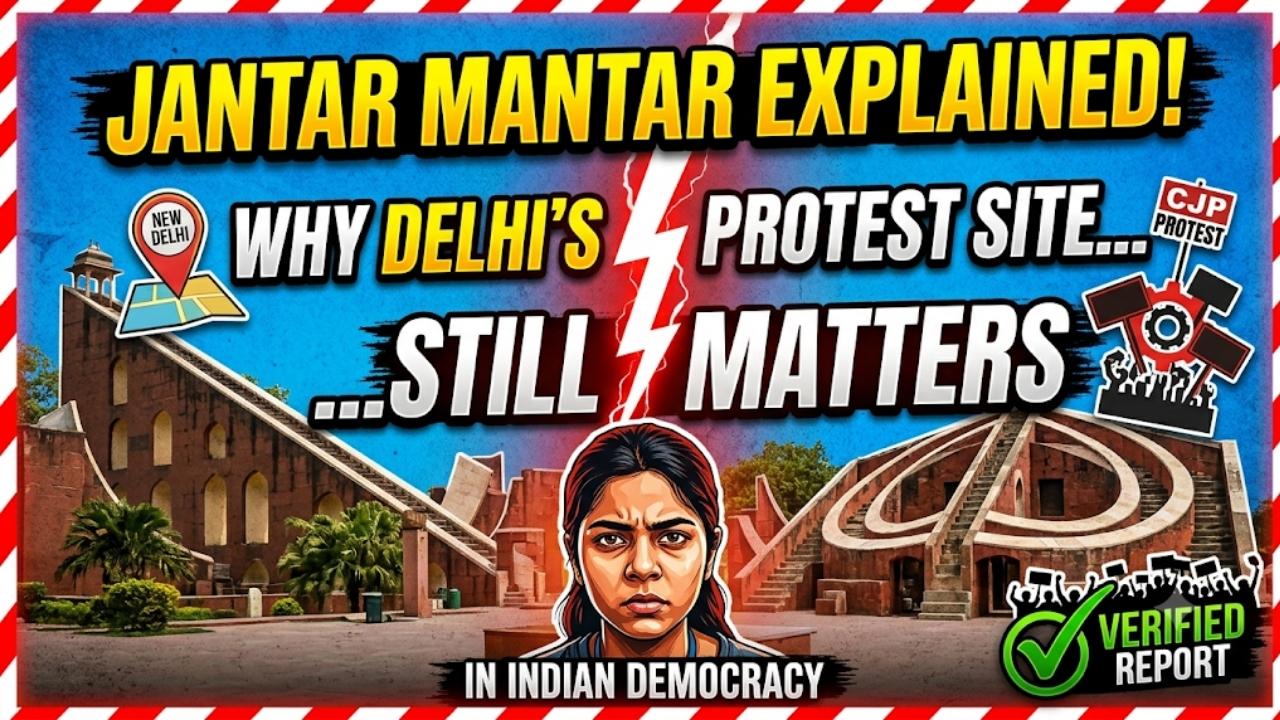
Ask any political reporter in Delhi where dissent becomes visible, and one answer returns again and again: Jantar Mantar. The road beside the 18th-century observatory is not merely a traffic stretch. It is a democratic stage — a place where ordinary citizens can turn private grievance into public claim within sight of India's power centres.
Understanding why today's student sit-in matters requires understanding why this site itself matters.
Geography of power
Jantar Mantar sits in the heart of Lutyens' Delhi, close to ministries, media offices, India Gate and the ceremonial axis that leads toward Raisina Hill. A protest here is automatically national. Cameras arrive. MPs notice. Diplomats drive past. That visibility is the point.
Authorities know this too — which is why permissions, barricades, section orders and dispersal tactics often concentrate here. Control of Jantar Mantar is, in practice, control of one of India's most important free-speech theatres.
A short history of protest at the site
Over decades, Jantar Mantar has hosted anti-corruption campaigns, farmers' groups, workers' unions, environmental activists, community organisations and student movements. Some protests lasted hours. Others lasted months. Some won policy shifts; others lost and left. Collectively they created a civic habit: when institutions fail, people come here.
That habit is fragile. Every attempt to permanently sterilise the space — through excessive policing or bureaucratic chokeholds — weakens democratic feedback. Every successful peaceful sit-in renews it.
Why students chose Jantar Mantar in 2026
- National visibility for NEET and exam-integrity demands.
- Symbolic proximity to Parliament during the session.
- Historical memory of earlier youth and civil society campaigns.
- Media density that forces official responses.
Protest site vs “law and order” narrative
Governments frequently frame Jantar Mantar gatherings as inconvenience: traffic, noise, security risk. Citizens frame them as constitutional practice. Both frames can be partly true — which is why negotiation, clear routes, medical access and restraint are healthier than blanket criminalisation.
The current movement shows the cost of getting that balance wrong. When force dominates dialogue, the site stops being a safety valve and becomes a pressure cooker.
What preserving Jantar Mantar really means
Preserving the protest site does not mean allowing violence. It means recognising that democracy needs a physical address for dissent. Digital outrage alone cannot replace bodies in public space. If Jantar Mantar is emptied of politics, Indian democracy loses one of its most honest mirrors.
That is why this corridor still matters — and why the world is watching who stands there today.