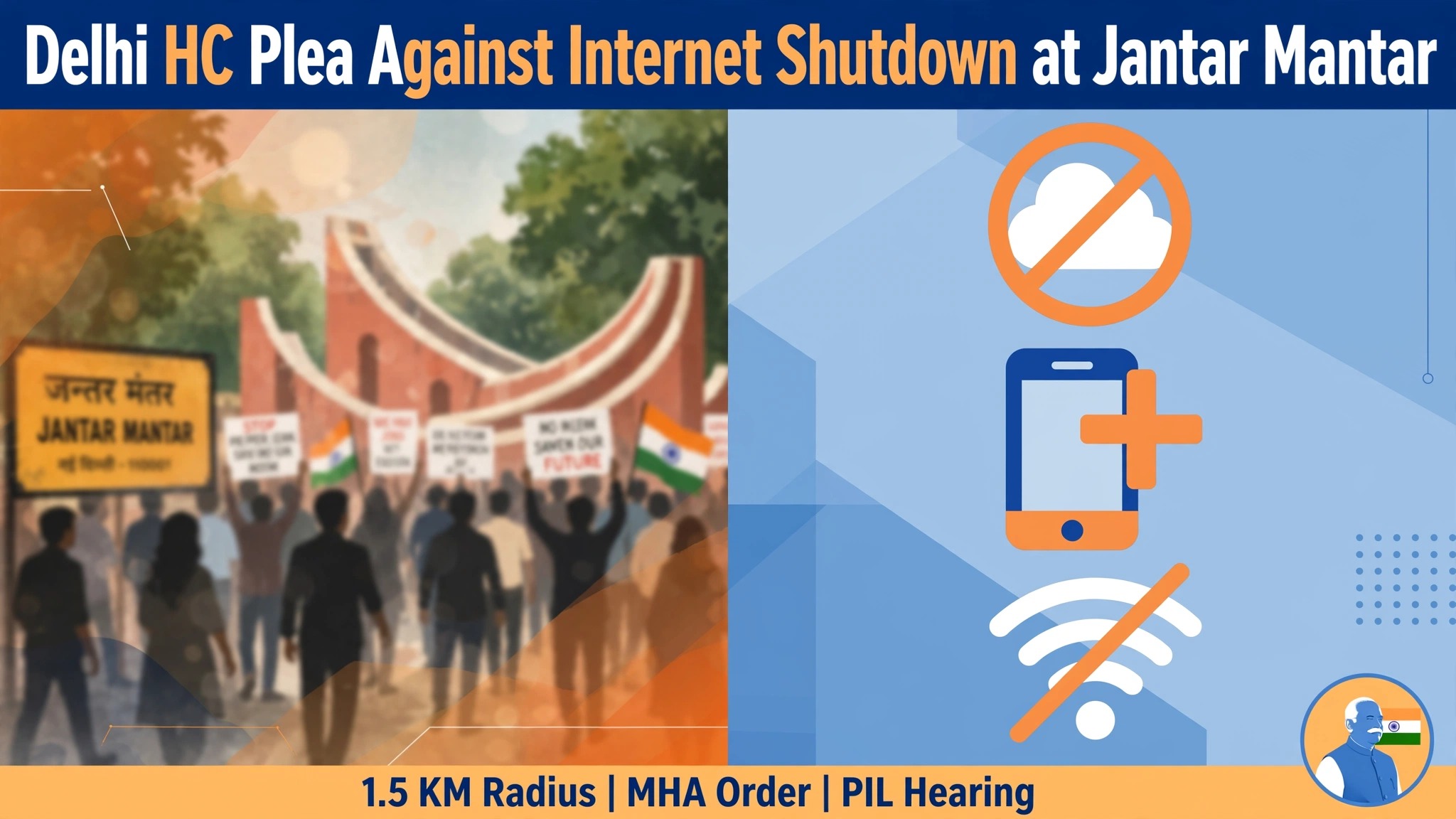
The battle over the Jantar Mantar protest has opened a new front — this time in the courtroom. A legal services organisation, the Software Freedom Law Centre, India (SFLC.In), has moved the Delhi High Court challenging the repeated suspension of mobile internet services in parts of central Delhi during the ongoing CJP-led agitation.
The plea puts a constitutional question at the centre of India's biggest student protest: can the government keep switching off the internet around a protest site without publicly justifying why?
What the petition says
The petitioner has asked the court to quash a series of orders issued by the Union Ministry of Home Affairs — on July 17, 20, 22 and 23 — directing the shutdown of mobile internet services in parts of central Delhi. According to the plea, the orders cover all mobile internet technologies within a radius of roughly 1.5 kilometres of Jantar Mantar.
The petition calls the suspensions “illegal, arbitrary and unconstitutional,” arguing that:
- The orders do not disclose any public emergency justifying the shutdowns;
- They fail to explain why a blanket suspension was necessary or proportionate to any alleged threat;
- Suspending telecom services is one of the most extraordinary coercive powers available to the Executive, because it directly interferes with freedoms guaranteed under the Constitution.
The plea also highlights a striking pattern: six separate suspension orders issued within about seven days. That repetition, it argues, makes it essential for the court to examine whether each order was an independent, lawful exercise of statutory power — or a rolling shutdown by another name.
Where the case stands
The petitioner's counsel mentioned the matter for urgent hearing before a bench of Chief Justice D.K. Upadhyaya and Justice Tejas Karia, which agreed to list it. The plea could not be taken up during court hours because of certain filing defects, so the substantive hearing is still ahead.
Why internet shutdowns matter at a protest
For protesters camped at Jantar Mantar, connectivity is not a convenience — it is infrastructure. Mobile internet is how demonstrators:
- Document police action in real time and preserve evidence;
- Coordinate food, water, medical aid and legal help;
- Contact families after clashes or detentions;
- Counter misinformation with on-ground footage.
When networks go dark around a protest, independent documentation weakens and official narratives travel with less friction. Combined with the closure of Metro stations in central Delhi, protesters argue the shutdowns amount to an access squeeze designed to thin the crowd rather than protect the public.
The legal standard: necessity and proportionality
Indian courts have previously held that internet access restrictions must satisfy tests of necessity and proportionality, and that suspension orders must be published and reviewable. Indefinite or mechanically repeated shutdowns sit uneasily with those principles. This case will test how far those safeguards protect a live protest in the heart of the capital.
If the court finds the orders defective, it could tighten the conditions under which governments impose protest-time shutdowns everywhere in India. If it upholds them, the shutdown playbook may become a standard response to street mobilisation.
The bigger picture at Jantar Mantar
The challenge lands amid an already crowded week: deadlocked talks between CJP and the Centre on the Education Minister's resignation, a Supreme Court hearing scheduled on pleas alleging excessive police force, a sweeping overhaul at the National Testing Agency, and Cabinet approval for a tougher anti-paper leak law.
Despite internet curbs and 18 Metro stations reportedly shut, the mood at the protest site has remained defiant. The courtroom fight over connectivity is now part of the same story — a struggle over how much space, physical and digital, Indian democracy allows its dissenters.
What to watch next
- When the Delhi High Court takes up the petition after defects are cured;
- Whether the Home Ministry discloses reasons for each suspension order;
- Whether fresh shutdown orders continue during the hearings;
- How this case interacts with the Supreme Court's July 27 hearing on police action.
This article is an independent, rewritten briefing for public information and search clarity. It summarises developments reported across public sources and does not reproduce any publisher's copyrighted text.