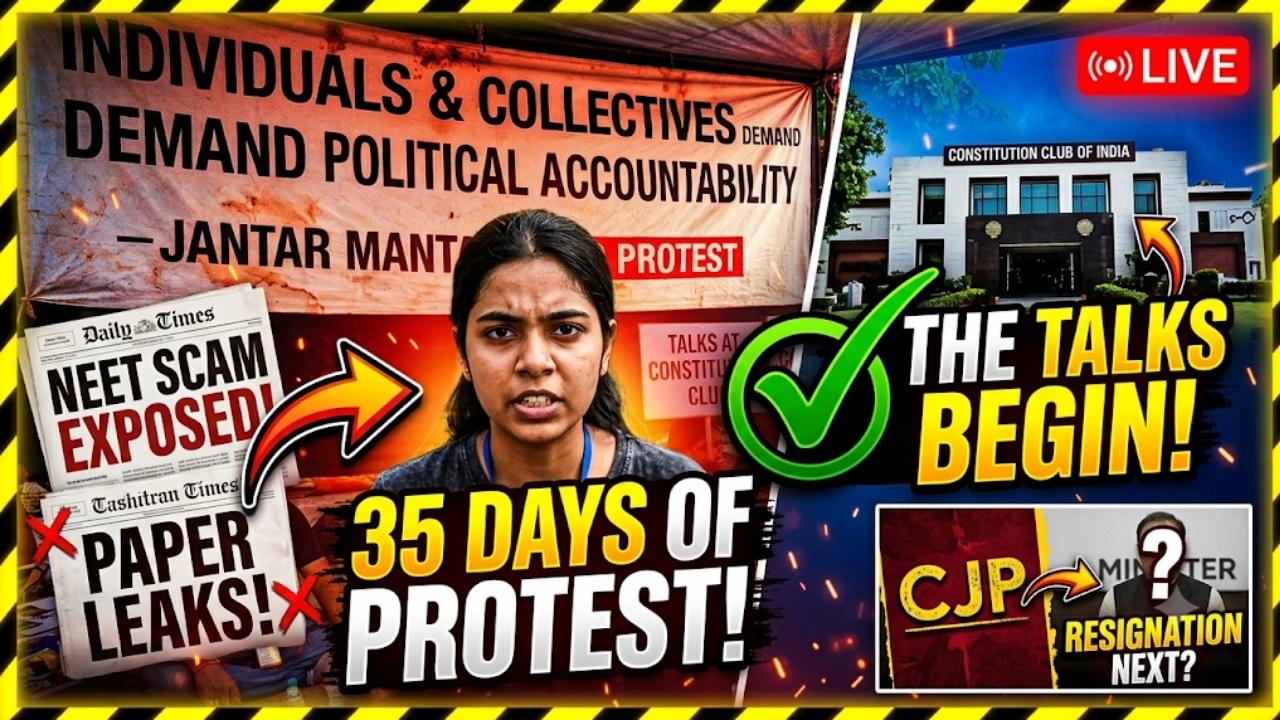
The indefinite sit-in at Delhi's historic Jantar Mantar has entered a decisive phase. After weeks of tension, injuries, hunger strikes and a police crackdown during a march toward Parliament, the Cockroach Janta Party (CJP) and the Union government have agreed to hold formal talks at a neutral venue — the Constitution Club of India.
For thousands of students, parents and civil society supporters camping near the protest site, today's meeting is not a victory lap. It is a test of whether political power will finally listen to a generation that says India's examination system has been hollowed out by paper leaks, coaching cartels and administrative failure.
What is happening right now at Jantar Mantar
Security remains heavy across central Delhi. Paramilitary and Delhi Police personnel continue to guard approaches to Parliament Street, Raisina Hill and the protest stretch itself. Despite that pressure, protesters insist the sit-in will not be dismantled until core demands are addressed — starting with the resignation of Union Education Minister Dharmendra Pradhan.
CJP spokespersons said they welcomed the Centre's acceptance of a neutral venue after earlier rounds of back-channel conversations. “A discussion has been called for. We are very happy that the government has agreed to our request that it be at a neutral venue. The Constitution Club of India has been chosen,” leaders told reporters.
Why the talks matter
Talks at the Constitution Club place both sides under public scrutiny. If the government only offers another committee or a future bill without answering the political demand for accountability, the protest is likely to intensify again. If CJP walks away empty-handed, campus networks across states may call for wider shutdowns.
- Neutral venue reduces the optics of one-sided summons.
- Live media coverage forces clearer statements from both sides.
- Student unions outside Delhi are waiting for a signal before escalating.
- Any written assurance on peaceful protesters' cases will be closely examined.
Background: from paper leak anger to a national sit-in
The agitation grew after alleged irregularities in competitive examinations — especially NEET — triggered nationwide anger. Aspirants argued that leaks destroy years of preparation and reward those with money and access. Over successive weeks, Jantar Mantar became the focal point where local grief turned into organised political pressure.
The movement escalated further when police used tear gas and batons during the “Sansad Chalo” march. Videos of injured students circulated widely, drawing condemnation from opposition parties and rights groups. Metro station closures and mobile internet restrictions near the protest zone added to the sense that authorities were trying to choke mobilisation rather than address grievances.
Sonam Wangchuk's hunger strike and the morning after
Activist Sonam Wangchuk ended a 26-day hunger strike after discussions involving senior Union ministers. CJP leaders said they were relieved for his health but underlined that the Jantar Mantar protest continues until the Education Minister resigns. That dual message — gratitude without demobilisation — is shaping the street mood today.
What to watch in the next 24 hours
- Whether any joint statement is issued after the Constitution Club meeting.
- Whether the government commits timelines on probe agencies and paper-leak legislation.
- Whether CJP softens or doubles down on the resignation demand.
- Whether police restrictions around Jantar Mantar ease or tighten overnight.
This live report will be updated as official briefings, protester statements and independent ground reports arrive from New Delhi. Bookmark this page for verified updates on the Jantar Mantar Protest.